About Don't Look Now
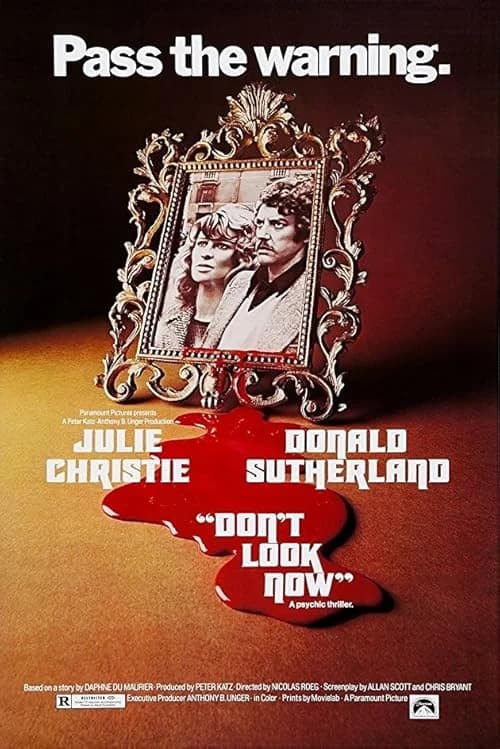
Nicolas Roeg's 1973 masterpiece, 'Don't Look Now,' is a seminal work of psychological horror and grief-stricken drama that remains profoundly unsettling. Based on a story by Daphne du Maurier, the film follows John and Laura Baxter (Donald Sutherland and Julie Christie), a couple who travel to Venice after the tragic drowning of their young daughter. As they navigate their sorrow in the labyrinthine, decaying city, they encounter two elderly sisters, one of whom claims to be a psychic with a message from their deceased child. This encounter plunges them into a disorienting world of premonitions, eerie coincidences, and a creeping dread that suggests their daughter's spirit is not at rest, warning of imminent danger.
The film is renowned for its masterful, fragmented editing and symbolic visual style, which mirrors the characters' shattered psyches and the nonlinear, intrusive nature of grief and premonition. Sutherland and Christie deliver performances of raw, vulnerable intensity, making their descent into paranoia and supernatural terror utterly believable. Roeg's direction is meticulous, weaving themes of time, loss, and perception into every rain-slicked alley and reflected image in Venice's haunting landscape.
Viewers should watch 'Don't Look Now' for its unparalleled atmosphere and intellectual depth. It transcends typical horror tropes to explore the psychological horror of bereavement, where the line between psychic phenomenon and desperate grief becomes terrifyingly blurred. Its infamous, emotionally charged editing and ambiguous, shocking climax have cemented its status as a classic. For anyone seeking a sophisticated, visually stunning, and deeply disturbing thriller that lingers long after the credits roll, this is an essential watch.
The film is renowned for its masterful, fragmented editing and symbolic visual style, which mirrors the characters' shattered psyches and the nonlinear, intrusive nature of grief and premonition. Sutherland and Christie deliver performances of raw, vulnerable intensity, making their descent into paranoia and supernatural terror utterly believable. Roeg's direction is meticulous, weaving themes of time, loss, and perception into every rain-slicked alley and reflected image in Venice's haunting landscape.
Viewers should watch 'Don't Look Now' for its unparalleled atmosphere and intellectual depth. It transcends typical horror tropes to explore the psychological horror of bereavement, where the line between psychic phenomenon and desperate grief becomes terrifyingly blurred. Its infamous, emotionally charged editing and ambiguous, shocking climax have cemented its status as a classic. For anyone seeking a sophisticated, visually stunning, and deeply disturbing thriller that lingers long after the credits roll, this is an essential watch.